Step 1
We receive your consent.
This gives us your authorization to apply for ERE certificates for the charging stations connected to your grid connection.
Every charging session at your charging station reduces CO₂ emissions. These savings are converted into ERE certificates: digital proof of avoided emissions. Fuel suppliers are required to purchase these certificates to comply with European climate regulations. As a result, your electric kilometers gain direct value, allowing you to generate annual revenue from your charging sessions.
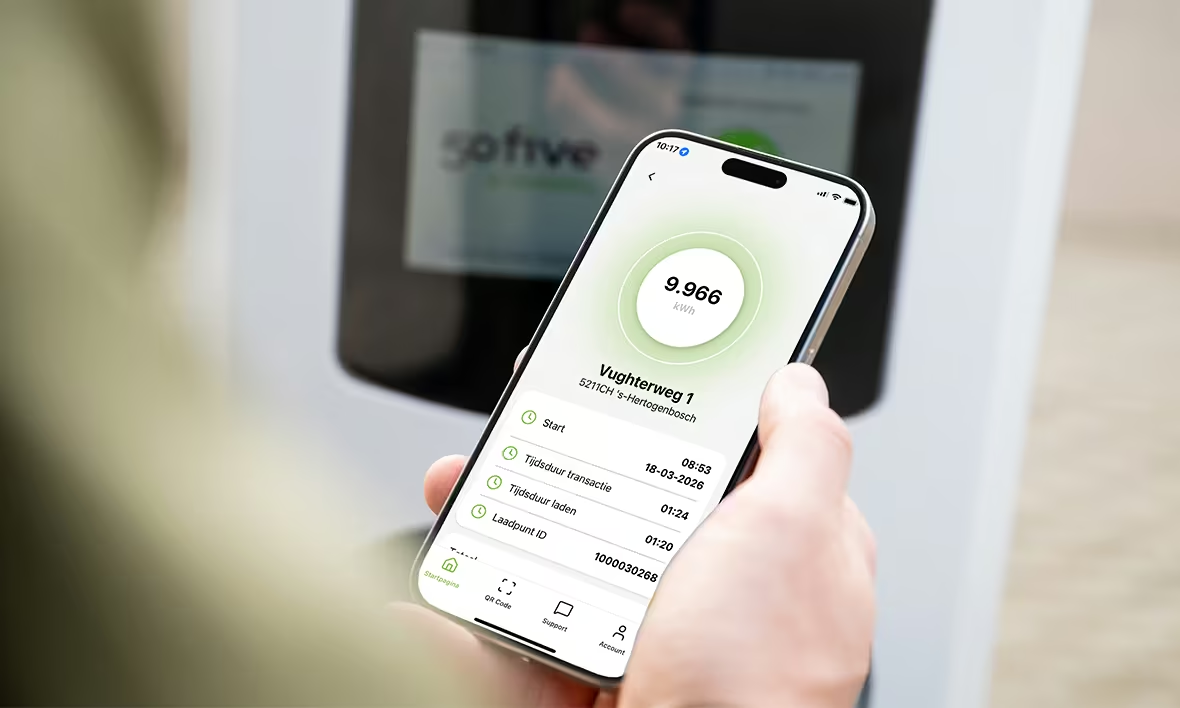
50five helps you claim and monetize ERE certificates through our role as an “Inboeker” (registry operator). Key features of our offering include:
50five handles the entire administration process for you.
Since 50five manages your charging station, we already have access to all validated charging transactions.
Flexible contract durations: 1, 2, or 3 years.
50five leverages its extensive network and market expertise to sell ERE certificates at the right price.
The longer the contract duration, the lower the fee:
1 year with a 23% fee (calendar year 2026)
2 years with a 21% fee (calendar years 2026–2027)
3 years with a 19% fee (calendar years 2026–2028)
EREs, or Emission Reduction Units, are digital certificates that demonstrate how much CO₂ emissions are avoided by charging an electric vehicle. Each ERE represents one kilogram of avoided CO₂ emissions.
Every time you charge your electric vehicle, you help reduce emissions in the transport sector. The amount of avoided emissions is recorded and converted into ERE certificates.
Within the European Union, this system is part of the RED III Directive, which promotes the use of renewable energy in transport. Companies supplying fossil fuels or energy are required to prove annually that part of their energy comes from renewable sources.
To meet these requirements, oil and energy companies can purchase ERE certificates from parties that actively apply clean energy in transport. This creates financial value for EREs. Starting in 2026, EREs will replace the former HBEs (Renewable Fuel Units) and become the primary mechanism for stimulating CO₂ reduction within the transport sector.
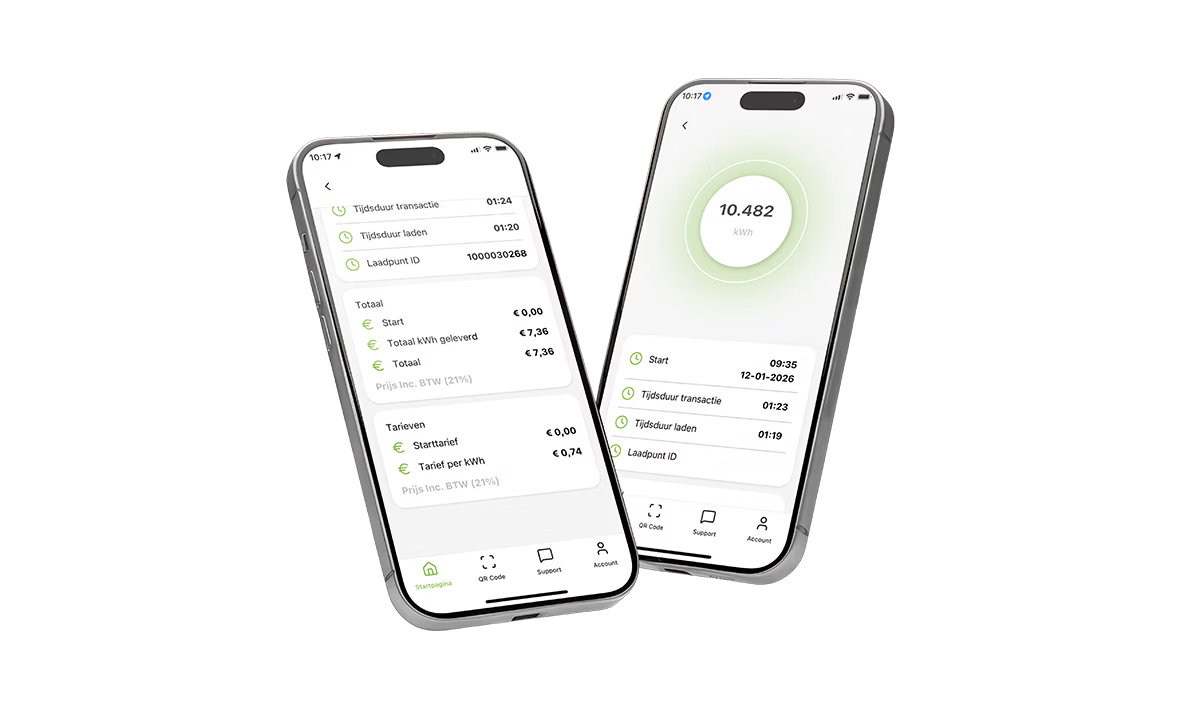
Starting in January 2026, private charging station owners and small businesses will also gain access to this system. Through certified providers, including 50five, your charging activity can be converted into verified ERE certificates. This gives charging your electric vehicle direct financial value for the first time.
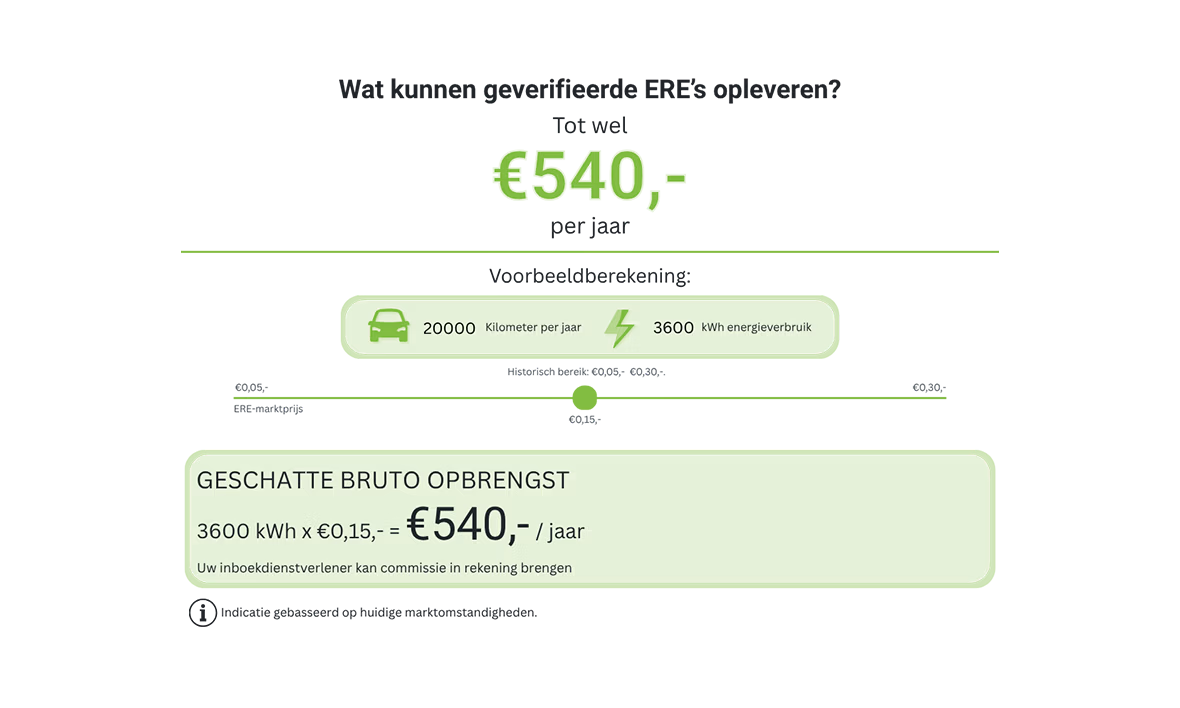
50five registers your charging data and converts it into certified ERE certificates. These certificates are then sold on your behalf to companies that are legally required to purchase them. The proceeds from these sales are paid out to you. Because every charging session contributes to CO₂ reduction and ERE certificates have a market value, this can generate a significant annual return. Your final earnings depend on:
The amount of electricity you charge
The current market value of ERE certificates
The current value of an ERE expressed in charged kWh, currently estimated at €0.15 per kWh
The value of ERE certificates fluctuates, so this amount should be considered an indication of the potential return.
You can register yourself through our 50five e‑mobility app. Please follow these steps:
Open the 50five e‑mobility app using the button below
Click on 'Fill in details'
Enter your EAN code, choose your mandate period, and agree to the general terms and conditions
Click on 'Submit details'
You can register yourself through our web form. Please make sure you have the following information ready:
EAN code(s) of your electricity connection(s)
Customer number of your account on the 50five platform
This gives us your authorization to apply for ERE certificates for the charging stations connected to your grid connection.
We carry out checks to verify whether all required information is available and complies with the regulations necessary to apply for the certificates.
We apply for the certificates associated with your charging station and trade them with purchasing parties in accordance with the regulations of the Dutch Emissions Authority.
Each calendar year, you will receive the payout for the traded certificates.


EREs are Emission Reduction Units, issued as certificates that demonstrate how much CO₂ emissions have been avoided through charging with renewable energy. One certificate represents 1 kg of CO₂.
ERE certificates are the successor to HBE certificates and are used to make transport more sustainable, this time also applying to private charging stations.
Major polluters such as oil companies are required to offset their emissions by purchasing certificate rights. This can be done through biofuels or through these ERE certificates. As a result, charging station owners can earn money from the electricity they charge.
ERE certificates can be claimed by the owner of the electricity connection to which the charging stations are connected. This applies to both private and business customers. A charging station is eligible if it is equipped with the correct internal meter (a so-called MID meter). Based on a charging station ID, 50five can determine whether the charging station is eligible.
EREs represent 1 kg of CO₂ reduction. To prevent ambiguity and exceptions, the Dutch Emissions Authority (NEa) determines that the average share of renewable energy in the national electricity grid defines the amount of this reduction. In the Netherlands, the average share of renewable electricity in the grid for 2026 has been set at 50.36%.
The formula is:
Number of EREs = supply (kWh) × renewable share (50.36%) × 183 (g/MJ) × 3.6 (MJ/kWh) ÷ 1000.
Supply (kWh): the amount of electricity demonstrably used for charging transport.
Renewable share (%): the average share of renewable electricity in the grid, or 100% if you can prove the origin of fully renewable electricity.
183 g/MJ: the European fossil reference value against which the CO₂ reduction is calculated.
3.6 MJ/kWh: conversion from kWh to megajoules.
÷ 1000: conversion from grams to kilograms of CO₂ equivalent; 1 ERE = 1 kg CO₂eq.
For example, someone charging 2,500 kWh over the course of a year could obtain approximately 830 certificates.
These certificates are traded by us at the best possible market price, with a fee ranging between 19% and 23%.
At a market price of €0.48 per unit, this would generate approximately €398.
At the current market price, this equals roughly €0.16 per kWh. In the past, this value has ranged between €0.05 and €0.30 per kWh.
To generate ERE certificates, a charging point must meet several technical and administrative requirements.
The most important requirement is that the charging point is equipped with a MID-certified energy meter. Only with this type of meter can the consumption of charging sessions be officially measured and registered.
For smaller connections (such as home chargers or smaller businesses), annual consumption generally remains below 75,000 kWh. For larger business locations, additional requirements may apply, for example regarding the origin of the energy used.
The exact requirements will be further defined in the regulations. It is therefore advisable to check whether your charging points comply with the requirements once the scheme is fully in effect.
No, not at this time. To create and maintain a practical system, the Dutch Emissions Authority (NEa) has decided that the calculation will always be based on the average share of renewable electricity in the Dutch grid. For 2026, this has been set at 50.36%.
We use your charging data, which we already manage for you within our platform, for administration and operational purposes. We handle this data in accordance with all applicable laws and regulations.
Applications for ERE certificates must be submitted per location and may contain only one EAN code per application.
The proceeds from ERE certificates go to the holder of the energy connection. This is the person in whose name the EAN code is registered and who can register with a registry service provider.
Even if the charging station is owned by an employer or part of a leasing arrangement, the connection holder remains the person who receives the proceeds.
Employers and employees may make mutual agreements regarding how the proceeds are distributed.
As of January 1, 2026, EREs can be claimed. If you register during this year, we can apply for and trade the EREs on your behalf retroactively from January onwards. This is done per calendar year.
We advise you to contact your employer and discuss this. This prevents you from potentially facing surprises later on.
After registration, 50five will perform a check to determine whether your charging station is eligible. The majority of charging stations managed by 50five comply. Should your charging station not comply, we will contact you.
The scheme is voluntary. If you have a charging station from your employer, please coordinate this further with your employer.
After the end of the calendar year, 50five will settle the EREs for the previous calendar year with you in one payment.
You grant us a mandate for 1, 2, or 3 years. We also use this mandate towards the Dutch Emissions Authority to demonstrate that we have been authorized by you.
Unfortunately, we can only carry out this process for customers whose charging stations are already on our platform.
The Tax and Customs Administration has determined that a fixed reimbursement for ERE certificates—received by an employee for charging a company electric car at home—does not constitute wages for payroll tax purposes. The reimbursement is not regarded as a benefit derived from employment, nor as wages from third parties. Consequently, the employer is not required to withhold payroll taxes.
Based on the current information, the ERE reimbursement may affect the amount an employer can reimburse an employee tax-free for the actual costs of home charging. The practical and administrative handling of this has not yet been fully determined, and more clarity is expected at a later stage. Employees are therefore always advised to coordinate this with their employer.
More information: KG:204:2026:16 reimbursement for ERE certificates for company electric cars | Tax and Customs Administration Knowledge Groups